

Edrak Blogs · Note
Where the Value Is Moving in AI

A note on orchestration, models, and the economics of useful intelligence.

The frontier is becoming a routing decision.
A company does not need the strongest model for every task: it needs enough intelligence to solve the problem, enough accuracy to trust the answer, a cost it can sustain, and control over where its data goes.
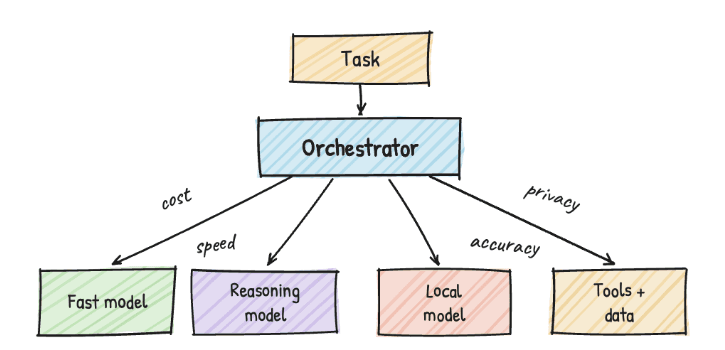
Those forces pull in different directions: the best answer may come from an expensive model; a local model may be cheaper, and more private; a fast model may handle routine work well, and fail on a hard problem.
The real work is deciding what should run where.
This is why the center of gravity in AI is moving toward orchestration; the useful product includes the model, the harness around it, the company's data, the tools it can use, the permissions it must respect, and the rules that decide how the whole system behaves.
Falling Model Costs Make Orchestration Increasingly Valuable
The harness matters more than most people think: it decides how an agent breaks down a task, what context it sees, which tools it may call, when it checks its own work, and when a person must approve the result.
A strong harness can make a smaller model surprisingly useful; a weak harness can waste the intelligence of a very capable one.
Models will keep improving, and their cost will keep falling. Open models are becoming more capable; closed providers are competing hard; chips are improving; inference is moving closer to the user.
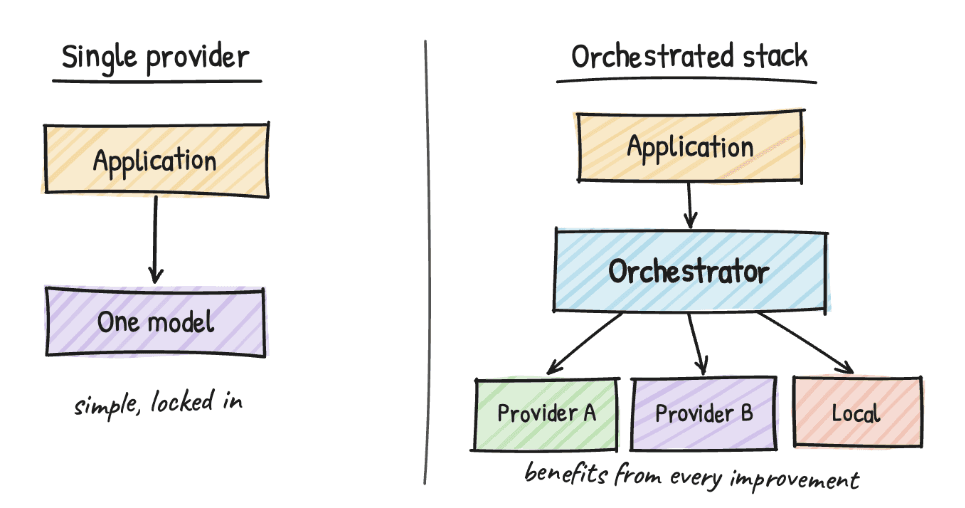
A product tied to one model receives most of these improvements from underneath it, while the provider still controls the economics.
An orchestration layer sits in a more interesting position; it can benefit from a better model from any provider, a cheaper open model, or more efficient local inference. Its job is easy to describe and difficult to do well: choose the right path for each step, and produce useful work as cheaply, and reliably, as possible.
Continuous AI Makes Routing Economically Necessary
I think the right unit of value will eventually look something like useful work per dollar, watt, and user.
Raw intelligence matters; the value appears when that intelligence reaches a real person, completes a real task, and does so at a cost the organization can afford.
Most employees will never know the practical difference between every model family, and they should not need to. A simple request can go to a fast, inexpensive model; a complex legal or financial analysis can go to a stronger reasoning model; sensitive data can stay on local, or regional, infrastructure. One workflow may use several models, along with internal tools, and company data.
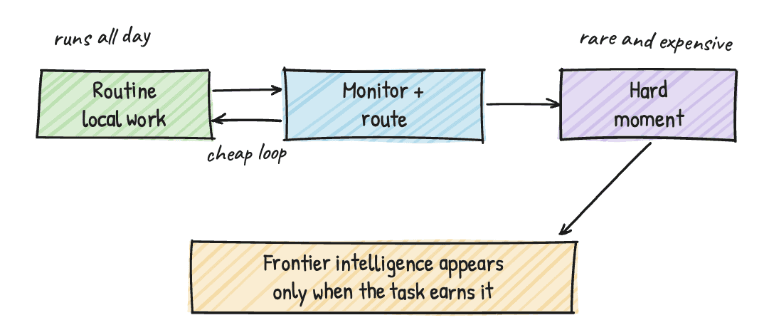
This is also how continuous AI becomes affordable. People imagine agents running all day, watching systems, completing tasks, and reacting to events; running a frontier model at every step would break the economics.
A practical system keeps routine loops local, and reserves expensive intelligence for the moments that deserve it.
Local inference will matter, for another reason: the most valuable context inside a company is often private, messy, and constantly changing. Moving all of it to a distant model is expensive, and creates risk; keeping more computation near the data makes the system faster, cheaper, and easier to govern.
Context + Workflow Integration Create the Durable Moat
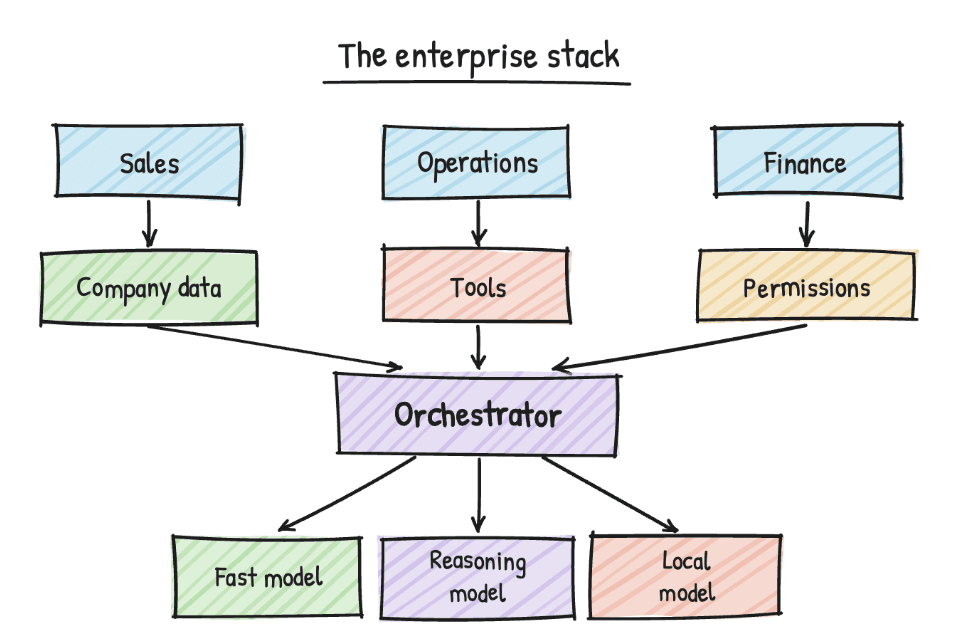
The model is only one instrument. The full system includes connectors, retrieval, memory, tools, permissions, evaluation, and the workflow itself.
The orchestration layer acts like a conductor: it decides which instrument should play, when it should enter, and how the pieces should fit together.
This changes where durable value can be built. Model performance will keep moving; today's leader may be replaced by a better release next quarter. The layer that understands the customer's work, connects to the systems where that work happens, and improves each time the workflow runs, can keep compounding through every model cycle.
The deepest advantage may come from context. A general model begins with broad knowledge; a useful enterprise system also knows the company's language, policies, documents, permissions, and past decisions.
That context turns intelligence into judgment that fits the organization.
The coming AI stack will probably look less like one all-powerful model, and more like a market of specialized intelligence. Some models will be fast; some will reason deeply; some will live on a device; some will handle sensitive data; some will call tools. The orchestration layer will decide how to combine them.
Therefore, value migrates from raw intelligence toward the control layer around it.
I think that is where the value is moving: toward the layers that make intelligence useful inside real systems. Models will keep changing; the durable work is connecting them to tools, data, and workflows, then deciding when each one should be used.
Written by Manar Ben Yahya
Edrak Blogs · Note