

Edrak Blogs · Note
AI deploys AI

As model intelligence becomes abundant, deployment becomes the scarce layer — and the next layer to automate.
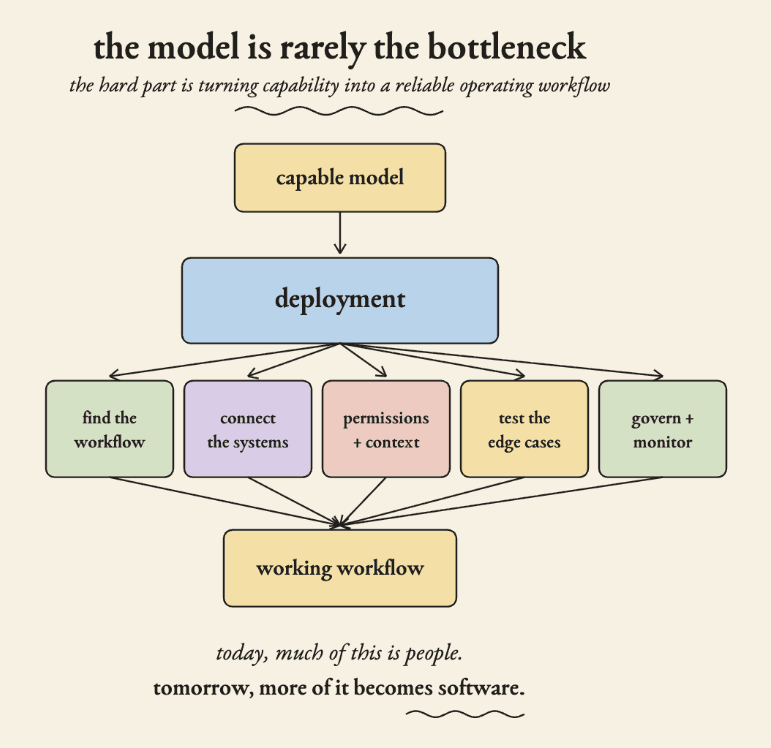
AI models are improving faster than most organizations can absorb them. The gap between a capable model and a working system is increasingly defined by everything around the model: the workflow, the data, the permissions, the context, the evaluation layer, and the operating controls.
Putting AI into production still requires someone to identify the right workflow, connect company systems, map permissions, encode organizational context, test edge cases, handle governance, and keep the workflow reliable after launch. Much of this remains bespoke, specialist work.
The next phase of enterprise AI is therefore recursive: software will increasingly perform the work required to deploy software. AI will help discover workflows, configure integrations, generate evaluations, validate permissions, manage rollout, and monitor other AI systems in production.
The economic transition
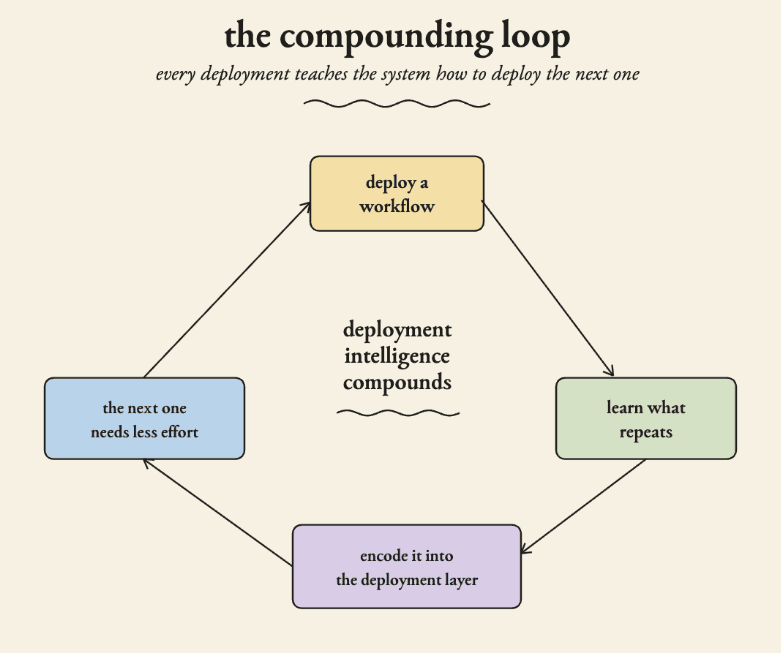
Today, deployment often behaves like systems integration: each new workflow creates new implementation work. Growth therefore pulls more human delivery capacity into the system. The software transition begins when repeated deployment work is captured as reusable machinery rather than repeated as labor.
A compounding deployment layer leaves artifacts behind: connectors, permission patterns, workflow templates, evaluation suites, rollout policies, observability rules, and traces of what failed before. Each deployment increases the amount of the next deployment that can be configured or validated automatically.
Each deployment should make the next one faster, safer, and cheaper
Why this becomes a software category
A mature deployment system does more than provide tools. It coordinates the full path from intent to production: discovering a workflow, understanding the surrounding systems, mapping permissions, configuring models and tools, generating tests, rolling out safely, and monitoring performance over time.
The central thesis is measurable. If deployment is truly becoming software, implementation hours per workflow should fall; time from discovery to production should shrink; the number of workflows managed per operator should rise; and reusable deployment components should account for a growing share of every launch.
The important object is no longer a single agent or model. It is the deployment system that can repeatedly translate new model capability into governed, context-aware, production workflows.
The category that follows
AI deployment is still dominated by people assembling the last mile between model capability and operational reality. If that last mile becomes programmable, deployment becomes its own infrastructure layer — persistent across models, workflows, vendors, and generations of AI capability.
That changes the role of AI itself. AI stops being only the object being deployed and becomes part of the mechanism that deploys, evaluates, governs, repairs, and improves AI systems. The deployment layer learns from every launch and converts that learning into the next launch.
The long-term implication is a recursive software stack: models create software, and deployment systems turn that software into working institutions. The more capable the models become, the more valuable the layer that makes their capability usable.
AI deploys AI.
Written by Manar Ben Yahya
Edrak Blogs · Public note